Old civil and tax registers - on which land taxes were based
and which also recorded licence-holders - bring back to life a
village quite different from the Liorac we know today and hold
a number of surprises.
The population was much higher in those days ; the 1845 census
recorded 697 inhabitants among whom 81 lucky landowners paid
property tax.
The great majority worked the land although those who actually
farmed their own land were few and far between and even
landowners often only boasted tiny properties which rarely
brought in a sufficient income for the family, hence the
necessity for many to carry out other trades at the same time.
The others - the share-croppers and ‘bordiers’ (the even
smaller share-croppers often working several families together
on the same piece of land) were at the mercy of short and
fragile tenancy agreements.
Naturally, none of this helped farming to evolve.
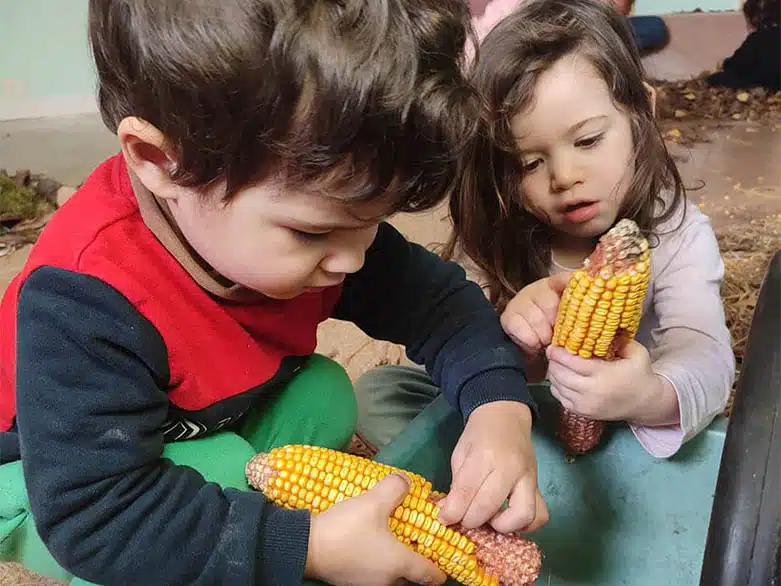
Family farms all cultivated the same crops with a large
percentage of the land being devoted to maize. Potatoes and
traditional vegetables were also grown with grapes, walnuts
and chestnuts bringing in seasonal extras. Hemp and linen, as
well as sheep’s wool clothed the villagers and provided work
for a variety of artisans.
In 1820 the village had a draper, Jacques Breton, a tailor,
Etienne Dussous, and a dyer, Jacques Gérard.
During the long winter months Pierre Lambert at La Gareille,
Jean Delbard at La Raffigne and Michel Bleyzac and Jean
Roussel at La Pigne worked as weavers.
Not forgetting feet...during the same period there was a
clog-maker, Pierre Comte, at Lescole and a shoemaker, Henry
Maceron, at la Restarie.
People were therefore clothed locally and spinning and weaving
provided extra income alongside farming.
The clog-maker also worked in the winter, hollowing out his
clogs from walnut wood when possible.
Which leads us to forestry work.
A far smaller area of the Périgord was covered in woodland
than today for the simple reason that local forges gobbled up
wood-coal at a fast rate. There was a charcoal-burner at La
Queyrouse and he was doubtless far from the only one.
In 1820 Liorac had two pit-sawyers, Pierre Jean Chort and
Pierre Coupet and two roofers, Henri Cadet and Henri Fougeri.
Jean Chassagne set up his carpentry workshop in the village in
1818 and was doubtless helped by members of his large family.
Jean Poumeyret also had his workshop at Liorac, encouraging
healthy competition.
There is no surviving evidence of the fabrication of the
famous flagstones whose remains are still to be found strewn
over many areas of Liorac today but there was a tile-maker,
Eloi Loubéat, in the village and a tile-seller, Jean Boussenot
at La Restarie.
The stone-mason, Pierre Grégoire, lived in the village.
There were a number of metal-workers at Liorac : the village
had an iron-smith, Antoine Mauquat and a blacksmith, Marie
Lambert. In the neighbouring village of Montclard there was
another iron-smith, Julien Giniat, and the smithy master,
Michel Benoît.
Mathieu Teyssier made the sharp, iron edge tools used by the
farmers of the neighbourhood and he was not alone as Liorac
villager, Gerrand, known as Ferroulex, carried out the same
trade at Lamonzie.
This was an era of self-sufficiency and the only artisan to
deal with food was the baker, Prat, known as Pradou. There was
no butcher as the pigs and chickens eaten by the villagers
came from their own farms and there was no grocer as markets
existed to fulfil this need. However, there were several mills
at Liorac each with their own miller : Jean Chadourne at
Moulin Neuf, Jean Bizet at the Moulin de Burette and Campagnac
at Moulin Boissière.
Village social life must have been quite hectic at this period
as no fewer than five cabarets paid licences to perform here.
There were four of them in the village, Jean Chassagne,
Guillaume Lambert, Claude Loublat and Pierre Lavergne and a
fifth, Jean Larouze, at Filolie.
As for the village notables, there was the mayor and his
country ‘policeman’, Jean Lauzeille.
There was a full-time and, doubtless, extremely influential
village priest but the Republican archives make no mention of
him.
It is still too early to find any evidence of primary or
secondary school teachers in the village - Jules Ferry has yet
to pass his education laws !
However, throughout the 19th century Liorac boasted a doctor
whose full-time presence was no mean thing in this era when
reoccurring fevers due to the stagnant waters of the marshland,
respiratory problems, nutritional deficiencies and a lack of
proper sanitation lead to a much higher rate of mortality than
the national average - statistics which were compounded by the
very high rate of infant mortality.
In 1818 Liorac was therefore very lucky to be cared for by
Doctor Charles Labigotie who lived at La Roche with his three
sisters, Marie, Ursule and Elizabeth Pourquery de la Bigotie.
One staunch Republican brother for three considerably less
Republican young ladies...
The Gay family who lived at Liorac, some of them at Garaube,
others at Genthial, Raffigne or Sorbier, also included a
doctor, Régine Simounet, who practised at Lamonzie.
Régine Simonet